Linde, university unveil autonomous forklift research
转载 2023-12-12 14:01 forkliftaction Source:forkliftactionLinde Material Handling and the Aschaffenburg University of Applied Sciences (UAS) have presented the results of a four-year research project into the viability of autonomous counterbalanced forklifts.
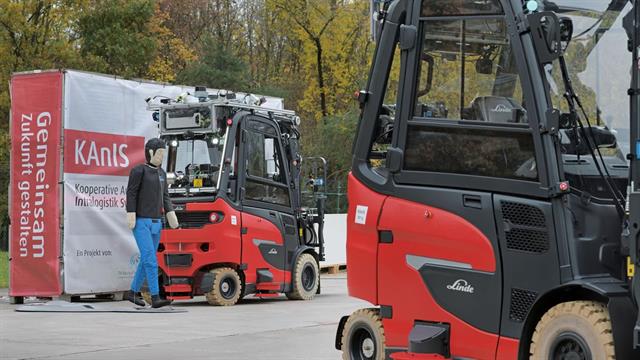
A crash test dummy was used to test the technology
As part of the KAnIS – Cooperative Autonomous Intralogistics Systems project, researchers presented live demonstrations on the test site at the Linde plant in Aschaffenburg.
During the project, solutions were developed for the demanding applications of autonomous counterbalanced forklifts, which transport loads both indoors and outdoors.
One focus was on the cooperative behavior of these vehicles that exchange information in real time via a 5G network and an edge server and can warn each other of obstacles.
The project was funded with approximately EUR2.8 million (USD3 million) as part of the Free State of Bavaria’s Information and Communication Technology research and development program.
“Autonomous vehicles will gradually take over more and more transport tasks,” says Stefan Prokosch, initiator of the KAnIS project at Linde MH.
“As a technology leader in the industry, the intralogistics specialist wants to make the benefits of autonomous vehicles available to customers who use counterbalanced forklifts to transport goods or load and unload heavy trucks.
“However, the requirements for forklifts operating in outdoor areas are much higher than those for purely indoor vehicles. These include the ability to operate on inclines and gradients, the presence of a significantly higher volume of people and traffic and different weather influences and temperature conditions that need to be taken into account,” Prokosch explains.
“Thanks to the joint research work with Aschaffenburg UAS, we have been able to develop viable solutions for these complex requirements. Once the project is completed, these findings will form an essential basis for further development projects.”
The overall goal of the project was to investigate how the cooperative behavior of networked, autonomous vehicles can improve operational reliability and handling performance.
“For the university, the KAnIS project was a very complex, interdisciplinary research project. Ten professors and numerous research assistants and students were involved,” says Professor Dr Hans-Georg Stark, project manager KAnIS, Faculty of Engineering at Aschaffenburg UAS.
Four Linde E20, E25 and E30 electric counterbalanced trucks with a load capacity of 2.0 to 3.0 T were automated and equipped with electrohydraulic steering (Linde Steer Control), the Linde Safety Pilot assistance system with electronic load diagram and an integrated fork positioner.
Next year the vehicles are to be further developed and tested so that they can perform four specific material handling tasks in the future, including the transport of wire mesh crates and pallets containing batteries,and the relocation of vehicle frames and overhead guards
A particular focus of the research project was on the automated forklifts’ perception of their surroundings in order to ensure their reliable interaction with other road users.
Part of the testing involved a crash-test dummy that suddenly emerges from behind a wall and runs into the forklift’s path.
Relevant Info
More- ROYPOW Showcases Integrated Material Handling Power Solutions at MODEX 2026
- ROYPOW Material Handling Power Solutions Shine at LogiMAT 2026
- Baufar Successfully Delivers Customized Lithium Forklift Battery Order for Vietnamese Client
- Clark expands European footprint with new Slovenia partnership
- Linde unveils high-tech experience centre in Basingstoke
- Electric forklifts gather momentum as manufacturers accelerate zero emission push
- UK forklift market set for 9.4% growth in 2026, industry forecast shows
- Hangcha Welcomes Canadian Dealer Delegation to Hangzhou
- See You Tomorrow, Stuttgart
- Next Stop: The 139th Canton Fair 2026!