While RFID (radio-frequency identification) technology has long ago entered into the consumer space — everything f...
While RFID (radio-frequency identification) technology has long ago entered into the consumer space — everything from smartphones to pets are loaded with data-laden tags — it’s had a more rocky experience in the industrial space. The technology, which aims to wirelessly transfer data via minuscule tags embedded in or on various products, didn’t quite stack up against the industrial environment. Either it was too expensive, not suitable for harsh environments, or didn’t broadcast its signal far enough to be of use. While many looked into or tested the technology, RFID never received the reception it has from consumer-driven space.
And Ed Nabrotzky, the Executive Vice President of Product Development at Omni-ID, has heard all the excuses. He says, “You wouldn’t believe how many customers I’ve met with who had a failed experience with their first try at RFID, and now they take another look at it, and it works in a way they never thought it would have worked before. It’s come a long way.”
![]()
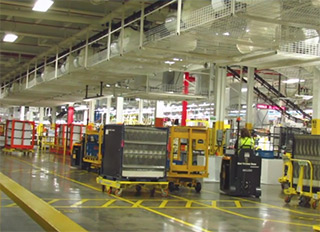
The Clyde, Ohio Whirlpool plant floor.
One of those companies was Whirlpool Corporation, and, in particular, its Clyde, Ohio manufacturing facility, which is 2.4 million square feet — the largest washing machine plant in the world. Bradford St. Louis, the company’s senior materials engineer, needed a better method of tracking the movement of parts down the washing machine paint line. He says that in the old system, workers used paper tags to identify each rack containing parts that had been painted so that a forklift driver would then be able to identify the parts. But tags tended to fall off, or be mis-read, which meant parts were delivered to the wrong locations. In addition, the desire to keep an up-to-date tally of parts meant three daily audits at a great time cost.
Nabrotzky adds, “These labels gave all the description, but, of course, once they printed it, they had no more visibility into it. They didn’t know where it was going.”
Add to that a major ramp-up in demand at the Clyde-based plant, and St. Louis was actively searching for better ways to ensure assets were accounted for and traceable as they moved through the plant. An early plan involved using printed bar codes, although that would have cost 4.5 cents per label. With the need for hundreds of labels daily, the costs of such a solution were unmanageable. But St. Louis and his team thought RFID might be able to offer the same benefits while being essentially free to operate, despite some of the concerns with the technology that he was already familiar with.
Omni-ID’s solutions were promising, as were their promises for the efficacy of new tags and receivers, with better ranges and more durability, which meant they could be placed on racks and not fretted over. In addition, the company offered their ProVIEW system, which uses electronically re-writable surface tags to display crucial information about a rack at-a-glance or display errors when parts are being moved to the wrong place.
In Whirlpool’s case, Omni-ID then took over and developed, tested and validated a system that could be immediately rolled out on the Clyde plant floor. That included all the software and hardware needed to make the system work. St. Louis says the hardest part of the implementation was running Ethernet cable around the plant to accommodate all the receiver stations, but acknowledged that’s a given process in just about any new plant floor technology advancement today.






 粤公网安备 44010602003952号