April showers bring May flowers. And, if you’re The Scotts Miracle-Gro Company, the start of the growing season...
April showers bring May flowers. And, if you’re The Scotts Miracle-Gro Company, the start of the growing season also brings orders for lawn and garden products. Between January and May, Scotts receives and ships 9,150 pallets of product a day from its 780,000-square-foot warehouse and distribution center in Marysville, Ohio, to support the busy growing season. The Marysville facility is just one of the distribution centers operated by Scotts, which markets the Scotts, Miracle-Gro, Ortho and Roundup brands in North America.
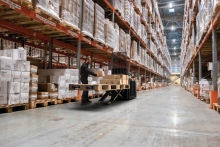
Forget conveyor, AGVs and automated storage. The primary tools at the Marysville facility are stretch-wrapped pallets stacked on the floor and moved by a fleet of lift trucks (Toyota Material Handling, U.S.A., toyotaforklift.com) operating 24/7.
To keep the fleet running during the peak season, Scotts implemented a fleet management program several years ago in Marysville. “We have a short window to ship our product, and we operate in a demanding environment,” says John Smith, manager of global raw materials. “Prior to putting in the fleet management program, it wasn’t uncommon to have two or three lifts a day down for repairs.”
That downtime led to lost productivity and increased rental charges to keep pallets moving. Since putting in the program, Smith adds, “I can’t remember a day that a lift has been down for more than a shift. If a lift can’t be fixed at our facility, our local dealer brings over a replacement to keep us running.”
In addition to keeping the trucks up and running, the fleet management program is creating a wealth of information about the repair history of each truck, operator performance and fleet utilization. Although Scotts is not taking advantage of that information at the moment, the lawn and garden company is compiling data generated by the program to improve performance and control costs in the future.
“This will help us define what we’re spending on planned maintenance and identify our unplanned repairs,” says Matthew Chute, senior buyer of indirect sourcing. “By comparing the performance of vehicles in different plants and with different operators, we believe we will be able to identify best practices and change the habits of people, which can reduce maintenance costs.”
Managing fleets
Scotts’ implementation of a fleet management program has been a gradual but steady process that reflects three warehousing and distribution trends:
• The importance of uptime and productivity in a conventional warehouse;
• The evolution of lift truck technology; and
• The need to better understand, control and reduce supply chain costs.
Like many manufacturers that produce and palletize product in batch runs, Scotts is primarily a conventional full-pallet-in and full-pallet-out warehouse. It does build a small number of mixed SKU and mini pallets for big box retailers—a practice that may increase in the future. For now, however, the vast majority of pallets are shipped out exactly as they come off the palletizing and stretch-wrapping line. As a result, productivity at most Scotts facilities is all about the number of pallets moved from manufacturing into storage and from storage onto the back of a trailer. Company wide, Scotts operates about 260 lift trucks.
At the moment, Scotts does not have operating metrics for the percentage of time a specific vehicle is operational or the cost of down time. However, given that the company spends about 6 months building up inventory followed by a short, intense period of shipping activity, it is acutely aware when lift trucks are out of service.
That was the case several years ago, when Scotts re-evaluated its lift truck requirements as a way to increase productivity. Part of that effort was the addition of single-double lift truck attachments in 2007. These allow Scotts to handle two pallets at a time. “We wanted to increase efficiency,” says Smith. “And we wanted to create a more ergonomic environment for the driver on the lift.”
To accommodate the single-double attachments, Scotts brought in a new model of lift truck that could lift loads of up to 5,150 pounds to a height of 15 feet 7 inches to reach the top of Scotts’ pyramid floor stacking pattern.
With the change in trucks, Scotts implemented a fleet management program managed by a local dealer. Initially, the program included a plan for regularly scheduled maintenance along with monthly and quarterly reports detailing what had been done to the vehicles and the parts and components associated with those repairs.
Over time, a dedicated, onsite technician was assigned to Scotts for one shift a day. During the busy season, that technician is available to make emergency repairs during the other two shifts. If a truck can’t be fixed and put back into service onsite, the dealer provides a replacement lift while the Scotts truck is out of service.







 粤公网安备 44010602003952号