By squeezing high performance levels into a smaller footprint than ever before, Clark’s latest compact reach truc...
By squeezing high performance levels into a smaller footprint than ever before, Clark’s latest compact reach trucks are ensuring customers make the most of their warehouse space, writes Hamon Stewart
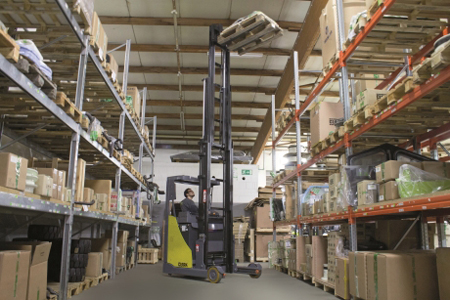
In an increasingly competitive and cost-conscious world, warehousing and storage operations require robust solutions together with tight control on resources. One way of achieving this is to maximise the potential of the storage space available. Compact reach trucks have therefore been developed for very confined areas to help operators of storage facilities keep aisle widths to a minimum and, where appropriate, to expand the number of storage units by using the regained space to full effect.
![]()
Reach trucks are so called because of their fork carriages, which reach over the stabilising legs and into racking, enabling impressive lift heights. As well as being very manoeuvrable in tightly restricted spaces, they offer highly effective storage handling capability.
Clark introduced its CRT13Kac and CRT16Kac compact electric reach trucks in July 2013, expanding its already substantial range of vehicles and complementing its more conventionally sized CRT14/16/20ac reach trucks. All these machines are intended for internal warehousing.
Nils Lieber, Clark’s product manager for the CRT13/16Kac range, explains, “The ‘K’ stands for the German ‘kompakt’, because of the narrow chassis.” The numbers 13, 14 and 16 describe the 1.3t, 1.4t and 1.6t load capacities respectively. Lieber explains further that the two CRT13/16Kac compact trucks have been specifically designed for “customers with drive-in racking where the narrow chassis profile of only 1,150mm is required… [with particular attention to] the capability of operating in narrow aisles with the maximum residual capacity possible”.
Counterbalance weights are generally not used in reach trucks as their function is replaced by the stabilising legs and positioning of the batteries. With overall widths of 1,150mm and 1,155mm, the CRT13Kac and CRT16Kac are notably narrower in the context of confined operating spaces than the 1,270mm-wide CRT14ac. The main principles and features were already established in the larger machine and Lieber explains that the challenges that needed to be overcome during the development of the CRT13/16Kac trucks were principally in “offering the best possible residual capacities by having a narrower chassis than in the normal reach truck versions [CRT14-20ac]”.
To offset the narrower width, while maintaining many of the operational characteristics of the larger machine, the compact trucks each have a longer wheelbase of 1,470mm compared with the 1,345mm of the CRT14ac, also apparent from the longer total length of the CRT13/16Kac machines at 2,543mm compared with 2,425mm for the CRT14ac.
All three machines have a lowered-mast height of 2,655mm and share the same free lift height (mast not extended) of 2,130mm. The maximum overall vehicle height with the mast extended is also consistent for all three machines at 6,620mm. The CRT14ac has a lifting height (total vertical fork movement) of 6,000mm, with the CRT13/16Kac machines following closely with 5,965mm. The reach distance (horizontal travel of forks) is longer for the CRT13/16Kac at 577mm compared with the 533mm of the CRT14ac. They are versatile machines with lifting heights from 4,160mm to 8,210mm, and include mast/fork carriages on all three machines that tilt to 3° downwards and 5° upwards.
Common Elements
Clark has included the features and comfort of its larger reach truck on the more compact machines and this is evident in a number of similar and identical elements across the range. The larger model is also replicated in the more compact versions with the almost identical overhead cab guard height of 2,100mm on the CRT14ac and 2,106mm on the CRT13/16Kac trucks, providing ample headroom for the operator.
Service weights (including battery) are the same for the CRT13Kac and CRT14ac at 3,350kg, whereas the CRT16Kac is a little heavier at 3,500kg.
All three machines have one driven 343mm front wheel and two non-driven 300mm rear wheels. As would be expected, the rear track width is larger for the CRT14ac at 1,177mm compared with 1,045mm on the CRT13/16Kac trucks. The height of the wheel arms is almost identical, at 227mm for the CRT13/16Kac and 225mm for the CRT14ac, whereas the distance between these supporting arms is 948mm for the CRT14ac and 848mm for the CRT13/16Kac. Laden ground clearance is also almost the same, at 73mm for the CRT13/16Kac and 75mm for the CRT14ac. Interestingly, the more compact machines have a somewhat larger turning radius of 1,726mm, compared with 1,610mm for the CRT14ac.
As these trucks are designed for operating in extremely confined spaces, Clark provides an optional guidance system in the form of rails and side rollers. This will be a considerable benefit in terms of keeping aisle width to an absolute minimum while maintaining maximum operability of the truck, as the operator can focus on the core tasks and considerably less on navigating the confined floor space within a very narrow aisle.
On the subject of durability, service intervals and downtime, Lieber says, “Optimum durability is assured by the use of proven components.” Clark actively promotes its keenness to use “high-quality components” to ensure the lowest possible maintenance costs and to minimise downtime: “Clark trucks are designed to operate longer and are more cost-effective than the competition.”
The company is also keen to point out that fewer parts and minimum wear equate to less downtime and a higher return on investment, so a total working-life evaluation is actively encouraged by Clark, which says that reliability and cost-effective lifetime operation have been an integral part of the design process.
Careful selection of reliable components results in a more durable machine capable of strong performance in demanding conditions, which Lieber illustrates in describing the Clark design: “Specially developed uprights for reach trucks with lateral reinforced beams absorb tensional stress and ensure a long service life. With the tilting fork carriage and integrated side shift, optimal residual capacities are achieved at all heights.”
The CRT13/16Kac and the CRT14ac are all electrically driven and have a 6.5kW traction motor (S2 rating, 60min.), enabling a maximum traversable gradient of 10% laden and 15% unladen. The CRT14ac has an electromagnetic service brake, while that on the CRT13/16Kac machines can be mechanical or hydraulic.
All three trucks have a top speed of 13km/h, whether laden or unladen. Also universal is the 15kW lifting motor (S3 rating, 15%), providing a lifting speed of 0.35m/sec laden and 0.5m/sec unladen and correspondingly a lowering speed of 0.5m/sec and 0.45m/sec. As a controlled reduction of the lift speed enhances stability and safety, while reducing possible damage to the load, Clark includes a cushioning function in the upright.
All three machines have a 48V battery (nominal capacity K5), rated at 465Ah for the CRT14ac and 620Ah for the CRT13/16Kac. Lieber points out that, “AC control gives the CRT13/16Kac optimum responsiveness in all warehouse operations… AC technology gives us all the normally expected features: regenerative braking, less downtime, reduced costs.”
Motor speed is controlled with precision, minimising hydraulic oil flow to use only what is actually required, improving efficiency and maximising the operational range. All three machines have an operating pressure of 180 bar for attachments, with the CRT13/16Kac delivering a maximum 25 l/min compared to the 30 l/min maximum on the CRT14ac.
Operator Comfort
The operator’s position is seated and equipped with a steering wheel. Due to the compact size of the smaller trucks, the seat height on the CRT14ac is somewhat lower at 1,050mm than the 1,150mm on the CRT13/16Kac. The seat is adjustable in a number of ways and is a generous size, despite the restricted room available. Careful attention has been paid to visibility of the load and the forks for the operator, and the overhead safety bars above the operator’s position are parallel to the line of vision to keep any impact on the operator’s visibility to an absolute minimum.
Clark has paid careful attention to operator comfort, and with features such as the adjustable steering column and the non-slip floor, the company has emphasised the importance of a comfortable working position, not only making the working environment more pleasant for the operator, but also maximising productivity due to the reduction in operator fatigue.
This clearly also has wider advantages and positive safety implications. The more compact machines are quieter than the larger version, with a value of <70 dB(A) given for the CRT13/16Kac and <80dB(A) given for the CRT14ac, which will benefit not only the operator but anyone else in the immediate vicinity, particularly in terms of having to communicate in what could otherwise be quite a noisy environment.
Standard features include an LCD display; steering wheel position indicator; 180° and 360° steering modes; tilting forks; and side-shift function. Lieber points out, “With optional mono-joystick, height indicator, video camera system, heated seats, cold store protection or full metal cabin, these trucks can be individualised to meet all customer needs.” Further options include a reversing buzzer, manual level pre-selector for 10 levels, working lights, and more.
Competitive Edge
When it comes to advantages over competitors’ vehicles, Lieber comments, “Our high residual capacities, even at higher lift heights, are very competitive – the choice between 360° and 180° steering is another benefit not all competitors have.” He adds that customer feedback comparing the CRT13/16ac trucks very positively with other vehicles they have used shows they are “delighted with the extra manoeuvrability, higher lift heights and increased residual capacity”.
Lieber predicts that the demand for smaller, compact forklifts such as these will continue to increase: “In the future, the development focus will stay on ergonomics and driver comfort, as it can be improved further still. Also, as warehouse space becomes more expensive, the need for smaller forklifts with higher residual capacity will increase.”
Compact machines such as the CRT13Kac and CRT16Kac have firmly established themselves as key equipment in the world of warehousing and storage. With the continual push to maximise the use of available space while minimising costs, it seems inevitable that compact reach trucks will maintain and probably expand their foothold in the marketplace.
Clark’s CRT13/16Kac machines offer a range of impressive features and options that will be valuable to operators of compact storage areas in a variety of situations and should deliver solid, reliable service, while living up to the challenges of demanding operations in very confined spaces.






 粤公网安备 44010602003952号