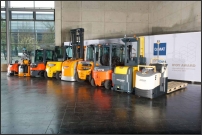
The winners of the International Forklift Truck of the Year (IFOY) Award were revealed last night (Monday 19th M...
The winners of the International Forklift Truck of the Year (IFOY) Award were revealed last night (Monday 19th May) at CeMAT, with some of the industry's biggest names walking away with their hands on a prestigious IFOY trophy.
A wide range of MHE competes for victory every year in the five categories of the IFOY Award, from counterbalanced trucks, order pickers, special-purpose machines or reach trucks through to AGVs. The competition covers all types of drive concept and all weight classes.
A direct comparison of the various trucks is impossible, and therefore no such comparison takes place - IFOY compares the nominated trucks with comparable commercially-available vehicles. For this purpose, the jury members can draw on two key instruments to help them make the right decisions: the IFOY test and - for the first time in 2014 - the IFOY Innovation Check.
The IFOY test measures the hard data and compares it with the data for rival machines. The IFOY Innovation Check focuses solely on innovations and the degree of innovation relative to the market.
In addition, the jury members - drawn from top industry journalists across Europe, including SHD Logistics editor Peter MacLeod, the only UK representative - drive all nominated vehicles themselves, putting them through their paces during the IFOY test day.
THE TEST
The IFOY test is based on the Andersom Test developed by Dutch trade journalist Theo Egberts. Since 1988, over 300 different trucks have undergone this benchmarking test, leading to the creation of the biggest comparison database of independent test data anywhere in Europe. This comparison database combined with the independent test enables the jury to compare entered trucks with their rival products, laying the foundation for an objective verdict.
All nominated trucks underwent testing over the course of a week in a purpose-designed testing hall on the grounds of IFOY partner Deutsche Messe/CeMAT in Hannover. The test focused on the practical use of fork lift trucks, and took into account cost-effectiveness, energy efficiency, sustainability, safety, ergonomics and design. Following the testing week, all trucks underwent testing by the jury members on the IFOY test day.
In order to address the question of innovation from a technological perspective, the technology used in the various trucks were compared with the market standards. For the purpose of the IFOY Innovation Check, scientists from the Fraunhofer Institute for Material Flow and Logistics (IML) in Dortmund assessed all the nominated trucks for their innovative character. Alongside the result of the IFOY test, the hard data provided by the Innovation Check formed the basis for the decision by the jury.
Written documentation submitted by entrants was analysed by IML, and the highlighted functions and features were compared to what is considered state-of-the-art in each category. The claimed innovations highlighted by the manufacturers of the trucks in their submissions were then ratified by visual inspection and functional checks.
COUNTERBALANCED TRUCK UP TO 3.5t
The IFOY Award in this category went to the Toyota Traigo 80. The new Traigo 80 is a sturdy, easy-to-operate and above all highly efficient fork lift truck for loads up to 2.5t.
According to the jury, the key factors in the choice of the Traigo 80 are its productivity and energy efficiency. "With the Traigo 80, the higher driving and lifting speeds combined with more powerful acceleration boost productivity by 20%. This makes it "one of the most energy-efficient forklifts in its class."
Toyota launched the 8FBMT25 series, better known as Traigo 80, last year. In the IFOY test, it scored highly for productivity and energy efficiency thanks to the maintenance-free Toyota AC motors, the newly developed control system and a more logical layout of components. The truck achieves a driving speed of up to 19km/h on load trips. The lifting speed has been increased to 0.68m/s unloaded (0.48m/s with load).
In terms of productivity, the performance of the electric truck in the IFOY test was above-average, while energy consumption is also lower than the market average. In all drive modes – high performance, performance and standard – the truck is more energy-efficient than average for its class. Toyota is therefore true to its word when it claims that the Traigo 80 has become around 20% more efficient.
During the IFOY test, the Traigo 80 made a robust and extremely solid impression. Whether battery cover, side panels or entrance, nearly all the elements are made of solid steel. The plastic components like the dashboard are equally robust and impact-proof.
The Toyota System for Active Stability (SAS) - which comes as standard - is a USP. Thanks to the steering synchroniser, the steering wheel is always in the ideal position during straight-ahead motion. Other SAS features include rear axle locking in bends, automatic tilt angle limitation, and limitation of tilting speed with raised forks and when the forks are automatically horizontally positioned during tilting. The IFOY test found that SAS almost always guarantees a high level of safety and productivity.
The Traigo 80 made an impressive showing in the test with its superb all-round visibility, its spacious and modern cabin, and the options for adjustment of the driver workplace to suit the needs of the specific driver. The compact design means that the Traigo can also be manoeuvred in narrow aisles.
The mast speed is fast and can be controlled via the mini-lever on the right-hand armrest. Mast dampening is also active in the lowest fork position. Through-mast visibility is also improved: the completely redesigned and broader mast (lifting height 3,300mm) provides the driver with a clear view of the fork ends. The mast segments can be retracted, saving a great deal of space and ensuring that the mast is always narrow, thereby creating a good line of sight along the mast. In addition, the redesigned protective roof provides improved visibility, making the truck ideal for work at heights.
COUNTERBALANCED TRUCK OVER 3.5t
The IFOY Award in this category went to the Jungheinrich EFG S40. Jungheinrich has optimised various existing technologies and combined them in such a way that mean for the first time a truck in this class achieves an operating time that, in ideal situations, enables it to operate for two full shifts without the need for a battery change.
In addition, the electric counterbalanced truck is powerful and perfectly suited to outdoor operation: in the words of the jury, this makes it a "real alternative to fork lift trucks with combustion engines".
In the summer of 2013, Jungheinrich extended its forklift programme with a series specifically designed for heavy-duty use. The "S" series comprises three electric models and one diesel model for use with add-on devices or with very low loads.
The EFG S40 demonstrated its power and precision during the IFOY test. With a top speed of 16.4km/h, it is fast enough to remain fully controllable with and without load. The braking power on the drive motor depends on the selected drive mode and is almost always at the level that the driver would generally expect. Thanks to the new "Pure Energy" concept, the Jungheinrich truck achieves added energy savings without any sacrifice in terms of productivity. Pure Energy consists of three components: three-phase technology, compact electronics, and compact hydraulics.
At its maximum setting, productivity is only 2.3% lower than that of high-performance 5t models, while energy consumption is a massive 42% lower, increasing to 48% in energy-saving mode (Drive Mode 3), which means that the battery (930Ah) in the EFG S40 is good for almost two full shifts.
The electric steering is precise and predictable. One new feature is the parameter steering, which adjusts the steering characteristics of the truck to suit the selected drive mode. This adaptive steering concept is a systematic development of the assistant system from everyday road vehicles for use in MHE units. The support from the electrical steering system is high at low speeds, which means that the driver needs to make fewer steering adjustments.
The level of support is lower at higher speeds. The main advantage is the precise steering, which is easy to control at all speeds. Undesired steering motions are minimised, thereby ensuring extremely smooth steering of the truck. The steering column is equipped with a lever for height and tilt adjustment. The automatic parking brake works smoothly and flawlessly, and mast operation is as expected. The response of the single "Solo-Pilot" control lever is precise and the speeds are satisfactory.
The cabin step-up is slightly higher than in other trucks in this segment, but sufficiently spacious and convenient to ensure safe and easy entry and exit. The grey non-slip grating is easily visible and further enhances driver safety. The footwell is generously dimensioned and free of obstacles. Both the throttle and brake pedals are set at a convenient height and distance.
INTRALOGISTICS SOLUTION
The IFOY Award in this category went to Toyota Material Handling Europe. At Spanish international logistics provider Carreras, the I_Site fleet management portal boosted productivity by 10% and cut the operating costs of the forklift fleet by around 60% within the space of a year. The Toyota system has subsequently been introduced at most of the Carreras locations in Spain and Portugal.
In stating the reasons for its choice, the jury said the key factors were the strong focus on customer benefit and the resounding success of the solution. The implementation of I_Site in combination with a number of organisational measures generated significant economic gains for the customer. The jury is of the opinion that Toyota has impressively demonstrated the potential that can be exploited through the use of web-based fleet management systems.
Following a trial run, Carreras introduced the Toyota I_Site fleet management system in order to reduce damage costs in the forklift fleet while optimising the handling of goods. Toyota I_Site was implemented in nine Spanish centres within the space of a year, and has recently been introduced in two Portuguese and two further Spanish sites. The system was implemented at the various locations by the warehouse managers and their operations and maintenance technicians. This process also took account of the experiences gained at the first Toyota I_Site location, the company headquarters in Saragossa.
The system helps the Carreras Group to maintain an overview of the deployment of the entire forklift fleet with the support of the web portal.
The company primarily pursues three goals: lower operating costs, improved safety and higher productivity. To this end, Toyota provided information from its pan-European service database and combined it with the technical, financial and administrative data of the Carreras fleet.
This data includes such things as driving data, which is directly recorded in the trucks and then transmitted via GPRS. Some 300 of the 450 trucks at Carreras are managed via Toyota I_Site. The project has been a complete success, as "we recorded 10% higher productivity and 57% lower fleet operating costs for the period from 2009 to 2011", reports Fabio Furukawa, productivity manager in the operations management unit at Carreras.
One direct consequence of the use of I_Site was the optimisation of work processes: all travel times were measured and new pick-up points for the pallets defined. The resulting transparency also enabled Carreras to optimise the working capacity of drivers and machines, and to improve the utilisation efficiency of the trucks and batteries.
"We were even able to optimise the fleet sizes. Although the implementation process necessitated additional investment, the benefits were so great that this investment has already paid for itself", says Jesus Carreras, the company's head of purchasing.
Controlled access via PIN codes also has significant benefits in terms of security. It ensures that only trained, authorised personnel can operate the machines. A ranking system for the five best drivers and other safety incentives additionally help to avoid damage and unnecessary costs. In the event of a collision or serious impact, the forklift can be blocked and restricted to crawl speed.
"This has made operation far safer. We have fewer collisions and accidents, and at the same time lower costs in areas like battery charging that used to be difficult to monitor", says Victor Dominguez, machine/installations manager in the operations management unit at Carreras.
WAREHOUSE TRUCK
The IFOY Award in this category went to the Crown GPC 3000 low-lift order picker with Crown QuickPick remote control. Thanks to the "magic glove", the operator can move the truck forward at the push of a button without having to be on-board and has both hands free.
In the view of the jury, the highly innovative and well thought-out magic glove remote control concept was the key factor in choosing the Crown GPC 3000 with QuickPick remote control for the award. The jury said that "in terms of its highly intelligent operating concept and outstanding efficiency, QuickPick Remote constitutes a genuine innovation that serves as a benchmark for all future semi-automatic order picking trucks".
The Crown GPC 3000 order picker with QuickPick feature was originally launched in early 2013. It came onto the European market in February 2014. The truck represents a new order picking technology that combines a Crown GPC 3000 low-lift order picker with an intuitive remote control system. Unlike in conventional pickers, the operator does not climb onto the picker to drive to the next picking station. Instead, he uses his thumb to press a button in his glove to navigate the truck to the next stopping point and walks alongside the truck.
Thanks to the glove solution, the picker has both hands free to pick. The operator recognises intuitively when it is better to ride along on the truck or to use the QuickPick function. Research by Crown shows that this saves time, making the picking process up to 28% more efficient and also safer and more convenient.
The IFOY test with the Crown GPC 3000 confirmed this assessment. With average distances, the system is already roughly 10% more productive than when the operator is on-truck. The shorter the distances, the greater the benefits of the system: with average order picking distances of 4m, QuickPick is a massive 39.5% more productive. During the test, energy consumption in QuickPick mode was significantly lower (-18%) despite the higher productivity. Overall, the order picking process is quieter, smoother and considerably less tiring for the order picker.
Laser scanners on the fork lift truck monitor the transport route as soon as the QuickPick feature is active. The speed is limited to the legal maximum of 4km/h instead of the maximum speed of around 12.5km/h.
Acceleration time over a distance of 10m is doubled from 4.9s to 8.9s. If the system detects an obstacle, the machine stops automatically, continuing on its way once the route is clear once again. Moreover, the order picker is able to keep to a preselected side of the aisle (left, right or down the middle) with the help of the Auto Steer Correction feature. Potential obstacles, like a pallet that is not in the shelf, are avoided, and the order picker then automatically returns to its original "lane". This ensures minimum impact on productivity.
AUTOMATED GUIDED VEHICLE
The IFOY Award in this category went to the iGo Easy concept from Still. The new combination of iPad and driverless EGV-S pedestrian high-lift stacker exploits the benefits of automation solutions in areas where the transport of goods was previously only feasible using a manually operated truck.
In the words of the jury, "The idea is fascinatingly simple: to make an automation concept for MHE trucks so convenient to use that any customer can easily install it himself and adapt it to suit changing requirements and conditions. The iGo Easy system from Still is a genuine innovation and is unique in the marketplace. Normally, transport systems always have to be commissioned up by the manufacturer".
Still launched iGo Easy at the beginning of 2013, having developed the first system solution worldwide that allows full configuration, control and monitoring via an iPad for simple and standardised transport jobs, such as provision and retrieval to and from the production line.
During the IFOY test, the solution proved to be highly intuitive and extremely precise. It all starts with the teach-in process, during which the easy-to-understand user interface of the iGo Easy app guides the user through all the automation steps.
First of all, reflectors are installed to identify the position of the truck, and the various positions are calibrated. To this end, the truck is manually guided along the desired route. A sensor built into the truck detects the reflectors and automatically transmits the coordinates to the on-board computer. The next task is to record the stopping points where the truck is to take on or unload pallets, the locations of the resting stations or the battery changing station. Up to eight stations can be logged. A height sensor stores - and subsequently monitors - the storage height of the pallets.
The app uses this data to generate and visualise the optimum route which can then be subsequently divided into segments and fine-tuned by the user. Changes to the route or settings, such as speed limits, one-way streets and station properties, can be made via the self-explanatory and intuitive iPad operating system.
After the route has been checked and approved, the truck can navigate its way fully autonomously through the warehouse and execute the learned commands: transport jobs are sent to the truck via WLAN by simply pressing the corresponding button of the mobile user device and automatically executed. The cockpit function complete with live image ensures that the user always has an excellent overview of the automated truck. The current position of the truck is shown on a virtual warehouse map, and important data such as speed, battery condition or transport jobs are displayed in the form of easy-to-understand graphics.
New transport jobs are easy to generate and scheduled jobs easy to modify via the iGo Easy app. Moreover, frequently recurring transport jobs can be stored in a fast selector feature. The system can be controlled not just from within the warehouse but from any point within the range of the WLAN network. A further advantage is that iGo Easy ensures that damage to fixtures or buildings is a thing of the past.
The high-lift truck is fitted with two sensors which monitor the surroundings through a full 360°. Two further sensors in the fork ends check whether the truck can actually drive into the waiting load.
![]()






 粤公网安备 44010602003952号