Moving the right pallets
From the start, Giant Eagle had determined that robotic industrial trucks would not move every pallet from the receiving dock. Instead, the intent was to create a process that used both lift trucks and robotic trucks to maximize both technologies and deliver productivity improvements. The question was: Which pallets should be moved by the robots, and where should they be delivered to achieve the maximum result?
That calculation didn’t just involve reduced miles traveled. The solution also had to take into account the fact that lift trucks traveled at 7 miles per hour while the robots traveled at 4 miles per hour unloaded and 2.7 miles per hour loaded.
“Our first step was to pull the data around our inbound pallets and then measure the associated travel with each pallet,” says Hurley. “For example, if the average travel time associated with one section was 4 minutes per pallet and another section was 2 minutes per pallet, then we would attack the 4-minute travel time first.”
As a starting point, the Giant Eagle team identified routes that involved travel distances of 200 to 300 feet from the receiving staging area to a drop zone, especially areas where high-velocity, high-cube items are slotted. “You simply can’t put everything in the front of the warehouse,” Hurley says. “That may be efficient for picking, but you sacrifice the ability to group items that are commonly picked together on the outbound side. The most efficient set up for order selection might not work on the retail shelf or in the labor design.”
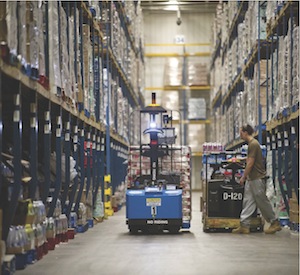
Once the routes with the greatest opportunity for improvement were identified, Hurley’s team created a delivery process and trained the robot on the route. The process consisted of a few basic steps. In the staging area, a team member loads a stack of two pallets onto the robot and scans a license plate bar code label with a truck-mounted scanner.
Once the WMS displays a putaway location on a screen on the robot, the team member keys in the relevant information and sends the robotic industrial truck on its route. When the vehicle arrives at the drop zone, an onboard bar code scanner reads the license plate bar code on the pallets as the mast is lowered. The WMS alerts a team member in the putaway zone that a load is ready for storage.
“When we started hauling pallets and measuring the results, we were taking between 20% and 30% of the associated travel time out of the process,” Hurley says. “We were excited about that.”
Man vs. machine
Determining what pallets and delivery routes would deliver the most bang for the buck was part of the learning curve. There was also a training curve with team members.
“When team members see a robot, the first thought in their mind is: Will this replace me?” says Hurley. “We emphasized that we could use technology to maximize our team members to deliver better value to our end customer.”
Accordingly, Giant Eagle did not reduce its head count, he adds. Rather, the company was able to reassign lift truck drivers to more valuable tasks, such as replenishment and order selection.
In addition, team members had to learn the rules of the road when interacting with the robots. For instance, if a team member on a lift truck and a team member on a pallet jack are in the same travel path, one is going to go to the left or the right so they can pass one another. The robot, on the other hand, is trained to follow a specific path. “Today, the robots are part of the flow,” Hurley says. “Team members work around them as if they were any other piece of equipment.”
In the spring of 2009, Giant Eagle added a robotic industrial truck in Pittsburgh and brought in two vehicles to the Cleveland facility. In all, Giant Eagle now has a fleet of eight vehicles. In Pittsburgh, robotic industrial trucks are delivering to a total of 14 drop-off locations. With more than five years experience under its belt, Hurley believes robotics will remake the grocery industry in the future.
“Our current design is just the beginning,” Hurley says. “What captures my imagination is the flexibility we get with robots and the possibility of adapting the technology to order selection and our outbound delivery processes. I think we could improve our store-ready pallet building capabilities because we wouldn’t be concerned about the travel component.”
System suppliers
Robotic industrial trucks: Seegrid, seegrid.com
Lift trucks: Raymond, raymondcorp.com; Yale Materials Handling, yale.com
Pallet rack: Frazier, frazier.com
Double pallet jacks: Raymond, raymondcorp.com; Yale Materials Handling, yale.com
Stretch wrap: Manual stretch wrapping
Bar code scanning: Motorola, motorolasolutions.com
Automated storage and retrieval system: Dematic (HK Systems), dematic.com
Claw attachment: Tygard Machine & Manufacturing, tygardclaw.com
Warehouse Management System: Manhattan Associates, manh.com
Voice-directed picking: Vocollect, vocollect.com
About the Author
Bob Trebilcock, executive editor, has covered materials handling, technology and supply chain topics for Modern Materials Handling since 1984.






 粤公网安备 44010602003952号