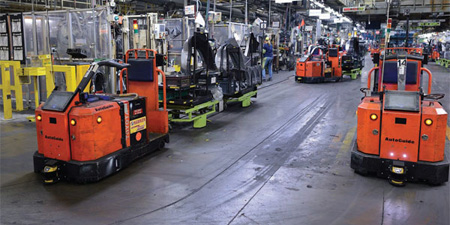
Because the AGVs travel the same paths at a consistent speed without so much as an inch of variation, they can safely navigate turns that would challenge human drivers—in some places, with less than six inches of clearance, according to Stafford. Congestion, collisions, sudden stops, and in-transit product damage have all been eliminated.
The labor savings have been equally impressive. The body-weld department has been able to reassign 42 people to other, more value-adding positions—including to the AGV implementation team—and nobody has been let go.
So far, the Toyota AutoGuide/AVINU project has saved TMMK more than $1 million annually, and ROI was achieved in just over one year. The payback has been substantial enough that the AGV implementation team will roll out the system elsewhere at Georgetown and will help to implement it at other Toyota auto plants.
The project foretells wider adoption of automation, not only in manufacturing but also in warehousing and distribution. In fact, AutoGuide attachments for Toyota pallet trucks and forklifts are already in the works. "I believe the automation market is limitless, although there will be challenges," Meyer said.
One of those challenges will be to convince warehouse and DC operators that automatic vehicles are not as complicated and expensive to purchase, install, and operate as they might think. That may not prove particularly difficult, however: Meyer estimates that the cost of a new, mass-produced vehicle plus the AutoGuide automation kit would be approximately one-fourth that of a custom-built traditional AGV. The fact that the AGVs are created from standard industrial vehicles and widely available, off-the-shelf components rather than proprietary controls will keep the cost down, he added.
Potential buyers will also want assurances of ready access to maintenance services for this new breed of AGVs, said Martin Boyd, vice president of product planning, marketing, and training for Toyota Material Handling U.S.A. Inc. That makes it critical to provide service for both the truck and the AGV components through the existing dealer network with its established relationships, he said.
Boyd agrees that lower-cost AGVs are poised for rapid growth. The economic downturn forced companies to look for waste, cut costs, and introduce more process efficiencies while considering how to better prepare for rapid change, he said in an interview at TMMK. Automation can help in all of those areas, and lift truck manufacturers will play a leading role in bringing it to a wider audience, he said. "We want to develop broader solutions around the customer to help them save money. We don't see automation as a competitor. We see it as an enabler."








 粤公网安备 44010602003952号