Developing alternative propulsion systems under full steam
转载 2012-10-30 10:34 still Source:stillThe Hamburg based STILL GmbH, leading supplier for customised internal logistics worldwide, is focussing on alternative propulsion technologies. Against this background, Still is going to inform about lithium-ion batteries, hybrid technology and new fuel cells used in the European intralogistics industry on the German Logistics Convention – the major convention of the German logistics industry from 17 to 19 October 2012 in Berlin.
An intact eco system is the basis for life for us and for future generations. For the Hamburg based STILL GmbH it is a matter of natural cause to use the resources of nature as careful as possible. Use of recyclable materials, gentle production methods, energy efficient products and environmentally responsible workplaces are at the focus of STILL just as are research and development of a wide range of alternative propulsion technologies such as hybrid, lithium-ion batteries (Li-Ion) or fuel cells. The name STILL stands for ecologic responsibility based on technical progress offering its customers a product portfolio that sets the standards for energy efficiency.
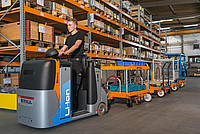
A CX-T tractor with state-of-the-art lithium-ion batteries presented on the logistics convention symbolises the high sense of alternative drives and ecologic responsibility at STILL. Compared to conventional nickel-cadmium (NiCd) and lead batteries, Li-Ion batteries offer a series of benefits. On one hand they are much more compact, requiring considerably less space so that much more energy can be stored consuming the same volume. On the other hand, these batteries are completely maintenance free. Also, the considerably shorter charging cycles of the Li-Ion batteries significantly increase availability.
The so called memory effect which is a reduction of the charging capacity over time does not occur in Li-Ion batteries either. This makes it possible to recharge type of battery also partly at any given time. Recharging the batteries just to a certain level does not have any negative effect on their capacity. Therefore Li-Ion batteries offer much more flexibility while needing less space, and, on top of all they are more environment-friendly.
Li-Ion technology is only one example of the broad range of alternative, eco-friendly propulsion technologies that are currently developed by STILL with great effort. Since 2011, STILL has been producing the RX 70 Hybrid in series. This made STILL the first company to produce a hybrid truck in series at all. The truck is based on the proven RX 70 diesel truck, the most energy efficient truck of its class. The hybrid version allows to save an additional 15 percent of fuel. The secret are the so called “Ultra-Caps” (high-performance double layer capacitors) mounted in the rear of the truck. These capacitors are capable to collect the energy released by the truck when it brakes and provide it later to the electric motor, when the truck accelerates again.
Meanwhile a large number of hybrid trucks from STILL are in operation at many different customers. In December last year, for example, an RX 70 Hybrid was delivered to ALBA Nord GmbH, a subsidiary of the ALBA Group which is a recycling company from Berlin. Klaus-Dieter Gehlhaar, Technical Director of ALBA Nord GmbH highlights “The low CO2 emissions and the clear plus in sustainability,” that enabled ALBA to extend its engagement in protecting the environment. Kühne + Nagel Expo Service, the trade show division of Kühne + Nagel, was the first forwarder to rent a whole fleet of energy saving RX 70 Hybrid trucks this year. Since then, 20 trucks of this kind are in operation at the trade show venues in Hannover, Düsseldorf, Cologne, Nuremberg and Munich. “We tested a range of trucks from the latest generation in trade show applications. The RX 70 Hybrid from STILL was by far the best truck in this test, providing a substantially lower fuel consumption than the models it was compared to,” says Andreas Kerkmann, branch manager of Kühne + Nagel Expo Service in Hannover. Altogether the RX 70 Hybrid is another module for higher efficiency and ecologic responsibility and an important step towards eco-friendly and efficient industrial trucks.
Another promising alternative propulsion technology for an ecologically responsible use of our environment are fuel cells that allow to operate industrial trucks to run on hydrogen. A chemical reaction between hydrogen and oxygen in the fuel cell generates electric energy that can be used to propel industrial trucks. The overwhelming benefit of this technology is that it emits no pollutants that strain our environment. The trucks neither emit soot particles or nitric oxides nor carbon dioxide. The only “exhaust fume” produced is pure water. However, this is not the only benefit of fuel cell technology: Compared to conventional electric trucks no batteries need to be changed or recharged during long charging cycles. A fuel tank can be filled in just five minutes. This makes the fuel cell highly superior to conventional batteries that require hours for recharging, and also, it is not necessary to provide a spare exchange battery to keep the truck available during recharging. This allows multi-shift operation without additional requirements.
In 2002 STILL had already developed a prototype of a fuel cell propelled forklift truck. Since 2003, trucks fitted with fuel cells have been tested in a number of pilot projects in practical applications. Amongst other, the trucks are operated at the airports in Munich and Hamburg, at the Hamburger Hafen und Logistik AG (HHLA) and at the chemicals company BASF. But it is not only in Germany that the trucks from STILL prove their qualities. Since September this year, for example, two RX 60-25 fuel cell trucks are deployed in a long-term pilot project at the Belgium retailers company COLRUYT. COLRUYT produces the hydrogen it needs for its own fuel station by electric energy generated from wind turbines and solar collectors. This makes the company a prime example for an organisation working to eco-friendly standards.
This month a total of four STILL fuel cell trucks are to be delivered to the DIY retail chain STARK in Denmark for another pilot project. “By using the fuel cell trucks in our company, we want to make it even more eco-friendly and make our contribution to reduce CO2-emissions in our country,” explains Henrik Lindstrøm, Director of Logistics at STARK.
However, it is not only alternative propulsion technologies making conventional gas, diesel or electric trucks as fuel efficient as possible, that are at the focus of development at STILL. This is why in 2008 the company had developed the Blue-Q technology, an intelligent autopilot for ecologic and economic responsibility that can be switched on by pressing a button in order to reduce energy consumption of industrial trucks by up to 20 percent.
All of these examples clearly show that the name STILL stands for driving innovations in the industry that set the standards for energy efficiency in clean and alternative propulsion technologies as well as in conventional drive systems.
Relevant Info
More- ROYPOW Showcases Integrated Material Handling Power Solutions at MODEX 2026
- ROYPOW Material Handling Power Solutions Shine at LogiMAT 2026
- Baufar Successfully Delivers Customized Lithium Forklift Battery Order for Vietnamese Client
- Clark expands European footprint with new Slovenia partnership
- Linde unveils high-tech experience centre in Basingstoke
- Electric forklifts gather momentum as manufacturers accelerate zero emission push
- UK forklift market set for 9.4% growth in 2026, industry forecast shows
- Hangcha Welcomes Canadian Dealer Delegation to Hangzhou
- See You Tomorrow, Stuttgart
- Next Stop: The 139th Canton Fair 2026!