Linde:From the development stage to the finished truck
转载 2012-05-24 13:49 Linde Source:LindeThe Linde Material Handling production and assembly plant in Aschaffenburg
From the development stage to the finished truck
Aschaffenburg, 21 May 2012 — With six production sites worldwide manufacturing a total of 74 different series with 170 models, Linde Material Handling (MH) is very much a full-service provider. Its product portfolio ranges from small electric lift trucks with 500-kg load capacities to large container handlers with load capacities of 52 tonnes, and also includes trucks designed for use in explosion-protected areas. The company headquarters in Aschaffenburg, Germany is home to the largest Linde MH production and assembly plant. This site manufactures combustion-engined trucks with load capacities of 1.4 to 8 tonnes, electric counterbalance trucks with load capacities of 1.2 to 5 tonnes and reach trucks with load capacities of 1.0 to 2.5. It is evidently a complex arrangement in terms of production and development. The distinguishing feature of Linde MH is the fact that all key components except the engine are produced at its plants in Aschaffenburg and the surrounding area, as well as in Ceský Krumlov in the Czech Republic. Such key components include cast parts, hydraulic pumps, lift masts, cabs, drive axles and steering axles. For production managers at Linde,achieving the objective of "customer satisfaction" primarily means providing the highest possible levels of quality and productivity with minimal throughput times.
The high vertical range of manufacture reflects the extensive technical expertise of Linde employees. Linde MH is the world's only mobile hydraulics provider that uses its hydraulic and electric drive systems in its own trucks. The drive systems are developed and produced by the second Linde business unit, Linde Hydraulics, although over half of the revenue for this business unit is generated from manufacturers of mobile working machinery. By working closely with both global OEM clients and its in-house truck development department, Linde Hydraulics has been able to secure its position as technological market leader. The diverse performance requirements and challenging application conditions in the construction and agricultural machine sector in particular are driving development in the field of hydraulics. This in turn is leading to improvements in the trucks.
From the initial idea to the finished truck
Around 200 employees from the Construction, Production Planning, Value Analysis and Testing departments work together in the development centre to tackle the ongoing challenge of creating innovative, powerful devices. Whenever a new truck is to be developed, market requirements and trends are first analysed, and specific product requirements from the marketing, service, production, quality and sales departments are discussed and agreed within the team. The subsequent design concept is then based on these findings, with new technologies and assembly and production requirements also being taken into account. "Design to Service" is an additional stipulation during the development process. All wear components should be positioned such that they are as easy to access as possible, and should be designed to make it easier to carry out future service tasks on the trucks.
A "marriage" every 20 minutes
Linde MH manufactures its products solely to customer orders, and the assembly halls in Aschaffenburg are where the different components that have been produced at the various sites all come together to make up the finished product. The units are transported around the assembly lines in a fixed cycle by induction-guided driverless transport systems (DTS). Every combustion-engined truck series produced in Aschaffenburg passes through three assembly lines: back-end, chassis and the so called "marriage" line. The most important assembly position on the chassis line is the position at which the drive axle is installed. The drive axle is located at the front of the truck and is one of the parts that requires special expertise to be fitted. The wheel motors in the axle form part of the hydrostatic drive, which is one of the components that gives Linde trucks such attributes as their precise driving and lifting characteristics, their impressive handling performance and their low energy consumption, and which makes them so easy to maintain. The back-end line is where the pre-assembled steering axle, engine, radiator and main silencer are fitted inside the counterweight and where the hose lines are laid and connected. The next line is the "marriage" or main assembly line, which is so-called as it is where the chassis and back-end units are combined. The truck moves around this assembly line, being assembled step by step until it reaches the final assembly station, from which point it can finally leave the line on its own wheels. For a diesel truck from Linde H40 to H50 with a load capacity of 4 to 5 tonnes, the entire throughput time from the first assembly cycle, including entry, servicing and finishing, amounts to just 1.8 days.
Depending on customer requirements, trucks may be fitted with a variety of special equipment, such as variations in the mast or engine model — virtually no two trucks are the same. "Dealing with this complex arrangement successfully is one of the greatest challenges that we face", explains Roland Hartwig, Vice President of Operations in Aschaffenburg. The company's logistics strategy also helps to achieve maximum efficiency levels. Only large installation parts such as counterweights, axles, engines or lift masts are fed into the main assembly with a herringbone-style layout. These parts are brought to the assembly site in sequence by internal or external suppliers. Smaller and medium-sized order-specific installation parts such as covers, exhausts, particle filters or trailer couplings are assembled to order on a special trolley in the order picking zone (known as the "supermarket"). This order picking trolley is assigned to the corresponding truck at the start of the assembly line and is attached to the DTS. This arrangement allows assembly workers to access all the necessary installation components.
The trucks go through several "quality gates" during the production process. Once a truck has left the "marriage" line, it is subjected to a series of checks before it goes on to be fitted with rear-view mirrors and doors in the final assembly stage. It then has to pass through a function test bench, where it is put through a complete set of tests, such as acceleration behaviour tests, required driving speed tests and tests relating to lifting and lowering speeds when under nominal load (i.e. with maximum load capacity). The truck can only leave the assembly hall and enter the shipping area once it has performed flawlessly in all the tests.
If a Linde truck must be scrapped at the end of a long service life, 99% of the truck can be recycled. 70% of the cast iron is used to produce new trucks, and all other materials such as steel, metal, glass, plastic, rubber and operating liquids are also almost 100% reusable and are returned into commercial circulation as secondary raw materials.
Linde Material Handling GmbH is based in Aschaffenburg and is one of the world's leading manufacturers of trucks and warehouse vehicles. It is also one of the most important producers of hydrostatic and electric drives, which are used in its own trucks as well as in mobile work machinery and road vehicles. Linde Material Handling GmbH is part of the KION Group, Wiesbaden, which is the European market leader for industrial trucks and the second largest manufacturer in the world. The company has around 13,800 employees and generated annual sales of EUR 2.856 billion in 2011.
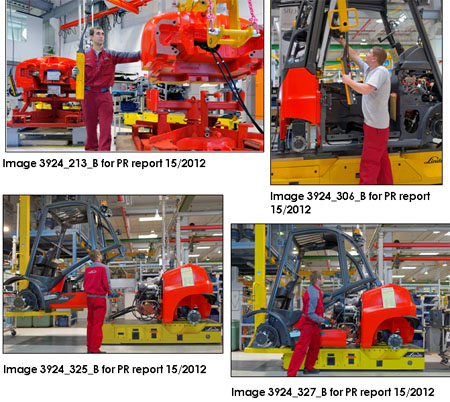
Assembly line of the electric counterbalanced forklift trucks Linde E 20 to E50.
Pictures below: The most complicated assembly step, the so-called "marriage", when the chassis with entire power train and the back end are precisely fit and bolted together.
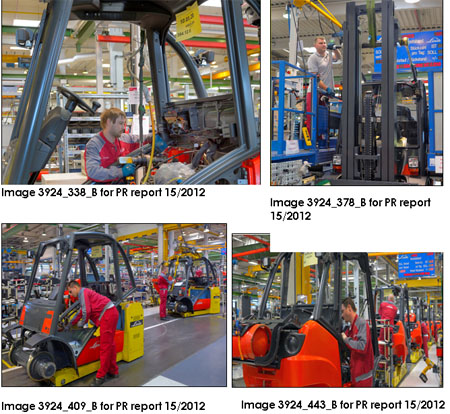
At the “marriage” or main assembly line the truck moves around in a fixed cycle by induction-guided driverless transport systems, being assembled step by step until it reaches the final assembly station. With the lift mast the forklift truck assembly has a second “marriage”.
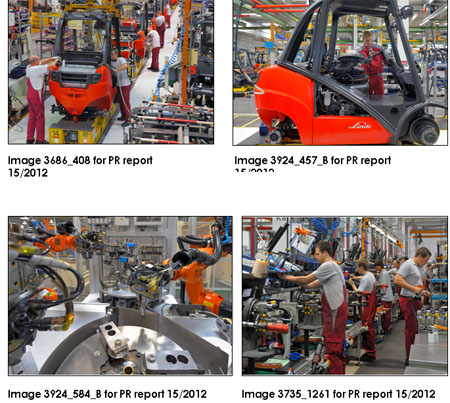
Pictures on top: The main or “marriage” assembly line of the combustion engined counterbalanced Linde trucks.
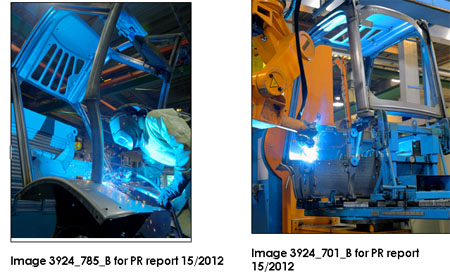
All key components of the Linde forklift trucks except the engine are produced at its plants in Aschaffenburg, for example the welding of the cabs.
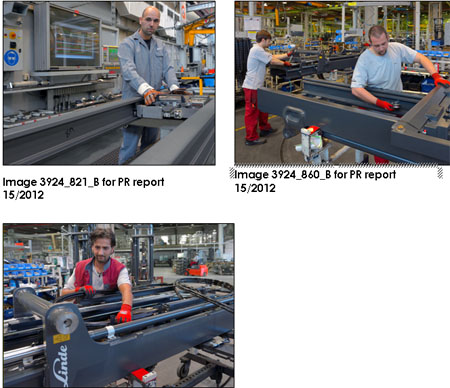
Highest accuracy and quality: Production and assembly of the lift masts at the Linde production site in Aschaffenburg, Germany
Relevant Info
More- ROYPOW Material Handling Power Solutions Shine at LogiMAT 2026
- Baufar Successfully Delivers Customized Lithium Forklift Battery Order for Vietnamese Client
- Clark expands European footprint with new Slovenia partnership
- Linde unveils high-tech experience centre in Basingstoke
- Electric forklifts gather momentum as manufacturers accelerate zero emission push
- UK forklift market set for 9.4% growth in 2026, industry forecast shows
- Hangcha Welcomes Canadian Dealer Delegation to Hangzhou
- See You Tomorrow, Stuttgart
- Next Stop: The 139th Canton Fair 2026!
- Going Global, Going Intelligent