Toyota Production System -Toyota Material Handling Europe’s Philosophy
转载 2011-10-11 14:07 Toyota Source:ToyotaAlthough Toyota Material Handling Europe (TMHE) itself was established less than ten years ago, its experience stems from two huge companies in the industry, BT and Toyota. These two companies have a combined experience of over 100 years, as the first BT hand pallet truck was created in 1948 and the first Toyota counterbalanced forklift truck was built in 1956.
TMHE’s mission is to be the first choice for material handling, whilst remaining committed to fair and honest business, something which will help the company to achieve its goal of becoming the most trusted material handling partner in Europe. This goal is far from unrealistic, as TMHE prides itself on the mutual respect between employees, stakeholders, and suppliers, as well as its own constant desire to improve.
By firmly placing its customers as a priority, TMHE manages to maintain a high level of trust and belief. This is enhanced by a continuous desire to enhance productivity, develop forklift durability, and improve safety and driveability for the operator.
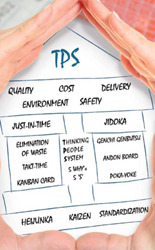
The principles which form the foundations of TMHE, can be easily explained using the Toyota Production System (TPS). TPS “empowers team members to optimise quality by constantly improving processes and eliminating unnecessary waste in natural, human and corporate resources.” These principles are applied by all team members in their daily work and relations with others.
TPS stems from jidoka, a concept introduced by Sakichi Toyoda (the founder of the Toyoda Spinning and Weaving Company) in 1918. Jidoka is automation with a human touch, and is now one of the two pillars of TPS. In 1937 Sakichi’s son Kilchiro established the Toyota Motor Corporation. He expanded on his father’s concept of jidoka with his philosophy of just-in-time (smooth, continuous, optimised workflows), and in 1953, these two concepts were merged to form a production line which responds to customer demand.
By implementing the process of on-demand production, the Toyota Group has discovered a cost-effective way to work, something increased by the use of heijunka. Heijunka is the elimination of muda, or waste, and within Toyota there are two types: mura (unevenness in workload), and muri (overburden or strenuous work). The principle of heijunka ensures that all production is carried out effectively, with no muda of staff, or goods.
To assist with the elimination of muda, Toyota has implemented takt time, a way of analysing the rate of customer demand. By optimising takt time, costs are kept to a minimum, owing to less waste and inefficiency, fewer delays, and less excess production.
This is excellent for customers, as products are of a higher quality, and delivered on time. Customers can also benefit from the Toyota Group’s philosophy of kaizen, or continuous improvement. “No process can ever be declared perfect but it can always be improved.” This idea focuses on what should be done, rather than what can be done, and will give customers the peace of mind that all material handling equipment is built with care to the highest standards.
The concept of genchigenbutsu (going to the source) complements this value, as all employees are encouraged to assess the problem for themselves by going to the root of the problem. Any technical issues are raised using the andon board, and all workers at Toyota have the authority to cease production if a fault is discovered. This is essential for standardisation, to maintain the high quality which the Toyota Group is renowned for. The risk of compromising quality is also reduced on the production line through poka-yoke, whereby machinery and equipment are clearly labelled to avoid error. This reduces the chance of delay, and ensures customers receive their ordered goods on time.
Toyota’s customers can also rest assured that any product purchased or hired from the Toyota Group will conform to the highest standards of operator safety, something which the company is highly committed to. Many of their forklift products include options to enhance driver comfort, reducing the risk of injury, and giving confidence to employer and employee alike.
The Toyota Production System is not just a process, but an attitude, and TMHE incorporates the principles of TPS into its whole organisation, from sales and marketing to product development and management. All team members are encouraged to nurture a sense of pride in the workplace, which ensures that every member of staff is involved in making TMHE as effective and efficient as possible.
The Toyota Group also cares about the impact their company has on the environment, and TPS also includes the 3Rs: reduce, reuse and recycle. TMHE’s policy is to constantly look for ways of reducing its carbon footprint through each stage of the product stages, including development, manufacturing, operation, and recycling.
In conclusion, TPS is Toyota’s way of showing its commitment to its customers, staff, process enhancement, and the environment. Both employees and customers should look forward to building a strong relationship with the Toyota Group, which is not afraid to embrace change and improve its current process.
Relevant Info
More- ROYPOW Showcases Integrated Material Handling Power Solutions at MODEX 2026
- ROYPOW Material Handling Power Solutions Shine at LogiMAT 2026
- Baufar Successfully Delivers Customized Lithium Forklift Battery Order for Vietnamese Client
- Clark expands European footprint with new Slovenia partnership
- Linde unveils high-tech experience centre in Basingstoke
- Electric forklifts gather momentum as manufacturers accelerate zero emission push
- UK forklift market set for 9.4% growth in 2026, industry forecast shows
- Hangcha Welcomes Canadian Dealer Delegation to Hangzhou
- See You Tomorrow, Stuttgart
- Next Stop: The 139th Canton Fair 2026!